Sunday, 12 January 2020

Day 15 – Saturday 4th January 2020

2C – Gentle (2-5kts) Breeze - no swell at all. Overnight cruise  from Deception Island to Charlotte Bay on the Antarctic Peninsula.

Our first sight of the Antarctic Continent
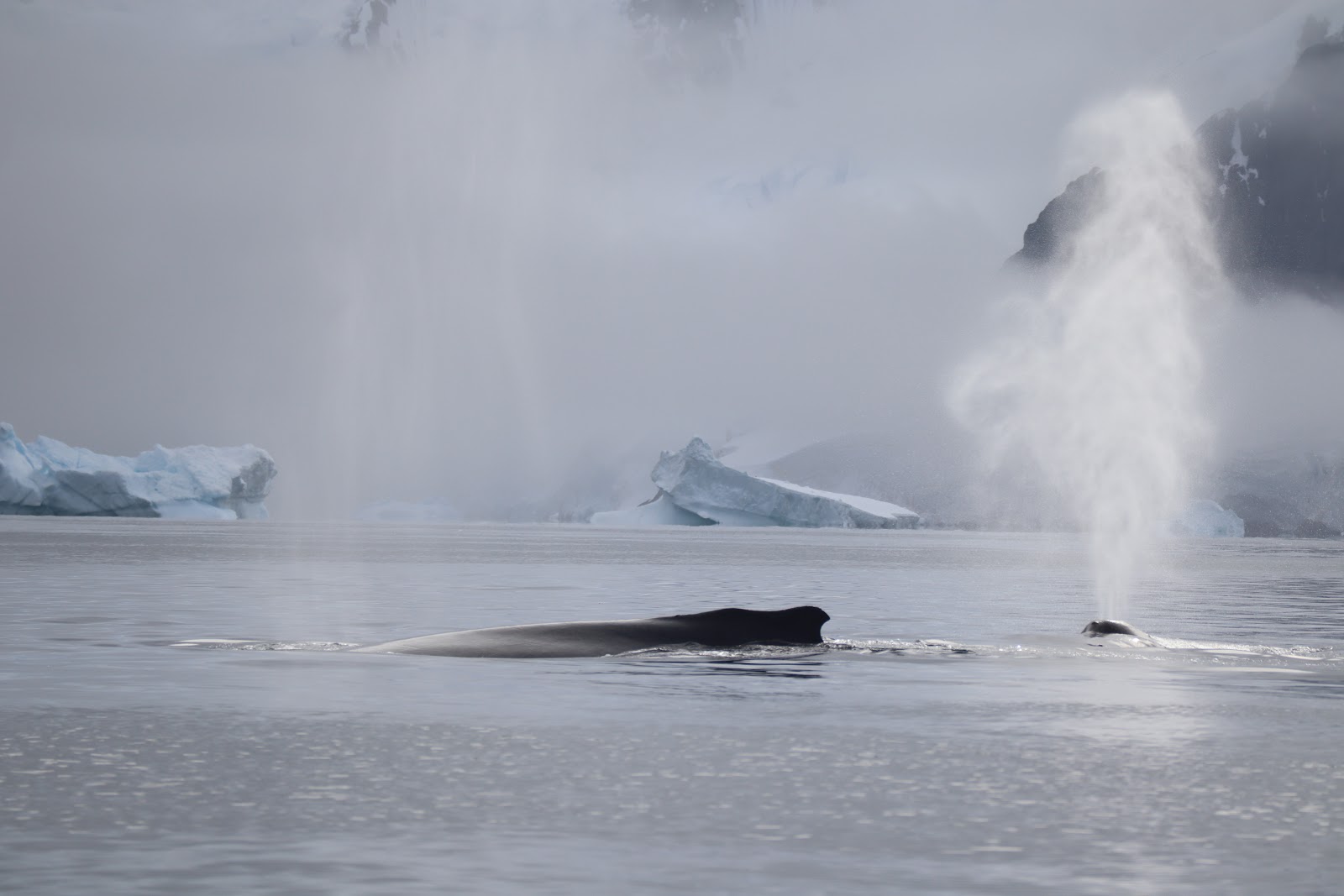
Early start for our zodiac cruise around Charlotte Bay watching Humpbacks from the zodiac, listening to them blow, even bubble-net feeding was very special and of course we were amazed by some big bergs.


Then we landed at Portal Point - the first time we set foot on the continental Antarctica.


We hiked around the point 

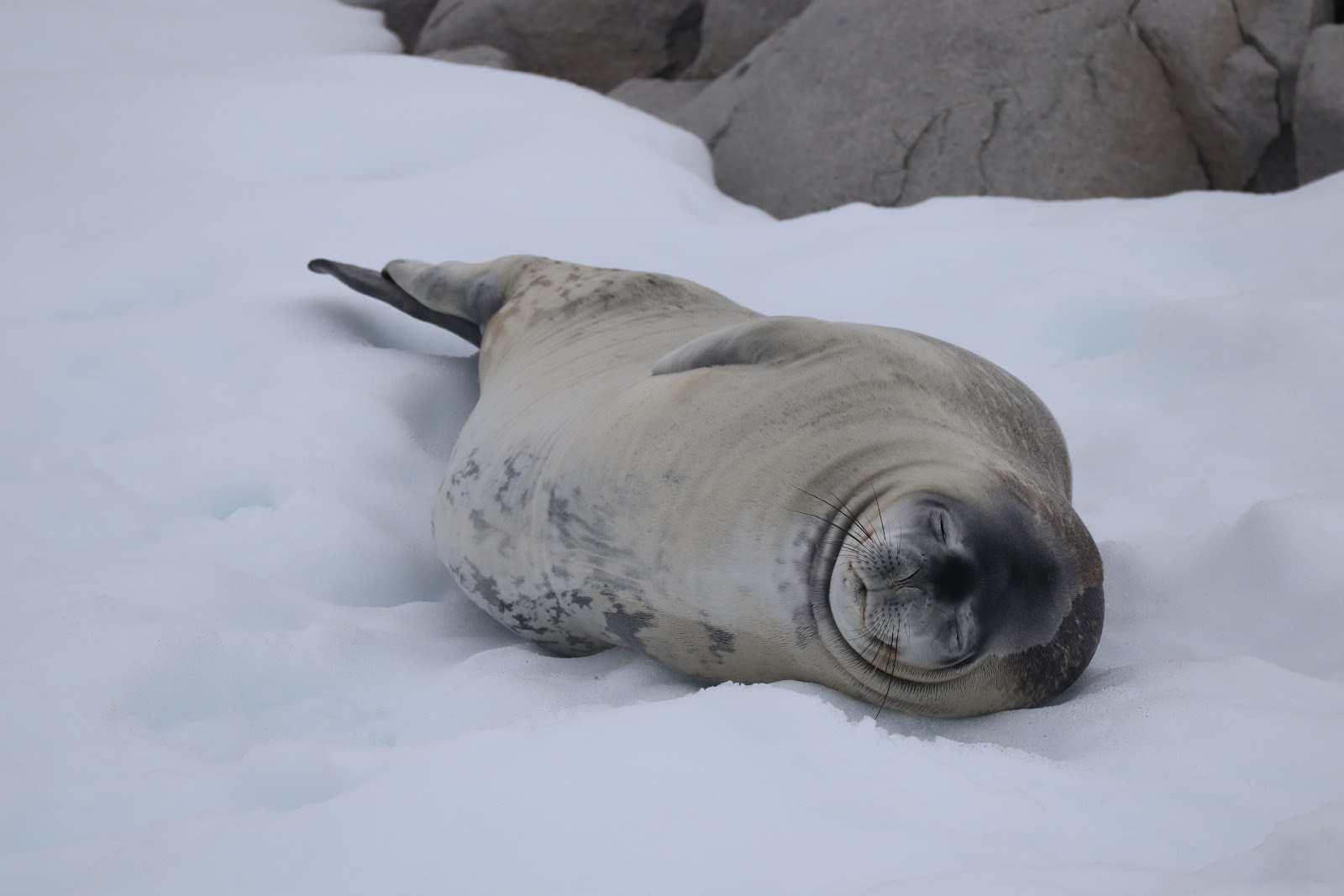
passed a few sleeping Weddell seals who hardly raised an eyelid 

and climbed to a vantage point which gave us a view over the whole bay. 


And of course we played in the snow:


Saturday, 11 January 2020

Day 14 - Friday 3rd January 2020


At sea - still on passage to South Shetlands
5C, 20kt winds, gentle swell no sun - due to the effect of the circumpolar currents and the Peninsula itself, we are seeing very few big bergs now. a little bit of local ice but nothing more.

Gym in morning before breakfast but another lazy morning – skipped a couple more lectures - busy reading a summary of the early Antarctic explorers - but still managed a couple of hours on deck watching the islands slide by in the mist and cloud - and still plenty of Humpbacks

After lunch we arrived at Deception Island which is an active volcano with a huge internal caldera which forms a safe anchorage and was home to a whaling station for many years and then became a British Antarctic survey base until an erruption in 1970 caused the place to be abandoned.

Initially we anchored on the south west corner of the island off Baily head which has one of the largest colonies of Chinstrap Penguins in the world - currently around 50,000 breeding pairs but declined from twice that number in the last 20 years or so.

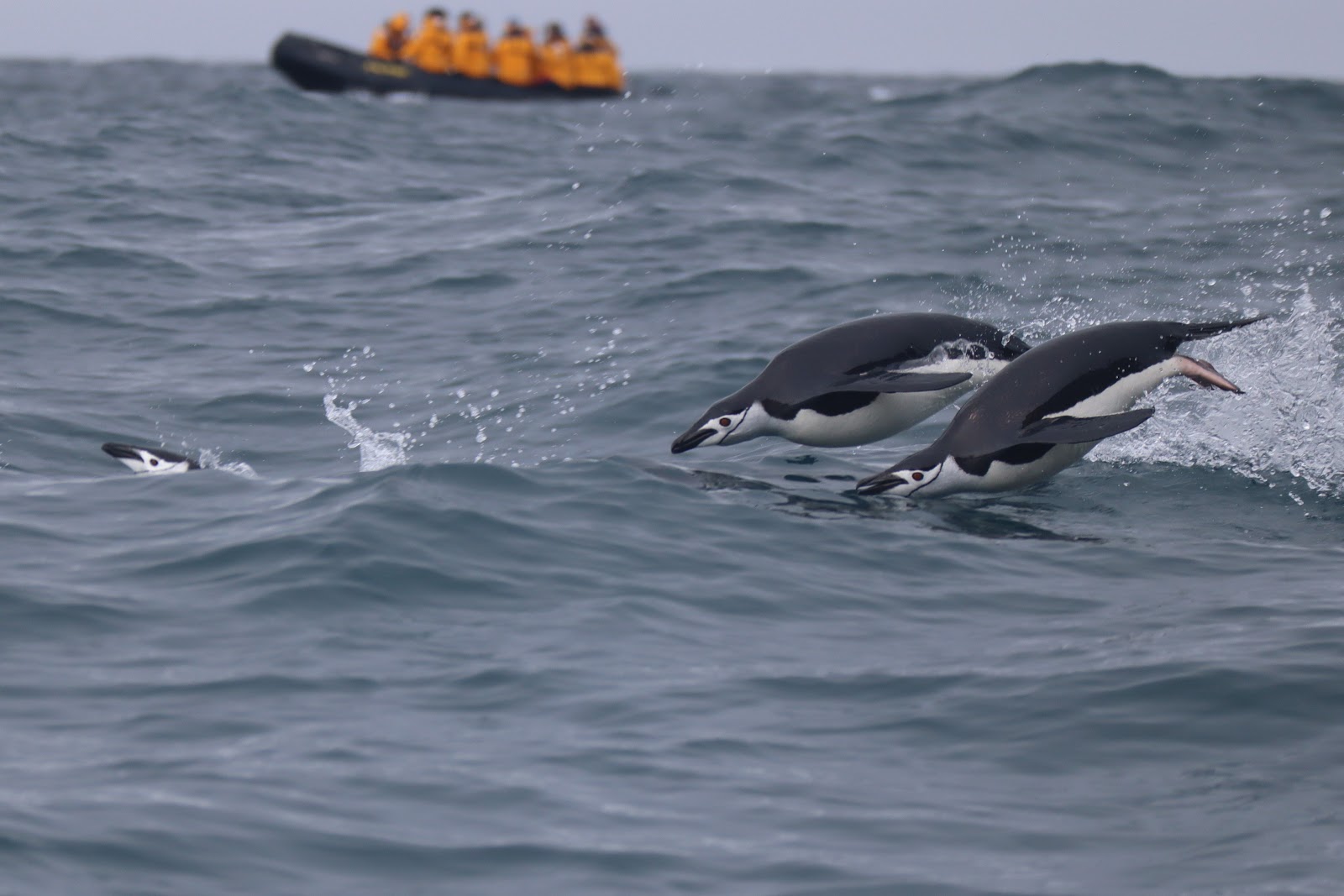
Unfortunately, there was a heavy surf breaking on the landing beach so we had to settle for a long zodiac cruise with Wayne instead, around the outside of the island, chasing after a couple of passing Humpbacks, watching the Chinstrap Penguins porpoising on their way to and from the beach


and getting close into some very small coves


before eventually cruising round into Whalers Cove and landing at the site of the British station,


where we found a couple of charter yachts and a number of Leopard seals relaxing on the beach - thankfully some distance from the landing site. There was a distinctly eerie feeling about the place as we wandered among the abandoned buildings with clear evidence of recent eruptions and a misty atmosphere.

Apparently the pair of Gentoo Pengiuns figured that they could move faster than the seal on the shingle beach.


Day 13 – Thursday 2nd January 2020

At Sea all day- 5C 15-20kt winds - enroute to South Shetland Islands - gentle swell and following wind and sunshine


Up for gym before breakfast, followed by a yoga class. Skipped the Geology lecture to watch for whales and sea birds but enjoyed Johann's talk on Whales.

Lazy day - whale watching and relaxing

Linda - whale watching

Enjoyed Alan's talk on his year at the research station in Signy island - clearly passionate about the Antarctic.


Day 12 – Wednesday 1st January 2020


 Missed breakfast, but up in time to see our approach to the South Orkneys. 0C outside, overcast with 10-15kt wind – gusting to 25kts.

This was not part of our original itinerary but resulted from the course we took avoid the weather.  It was a unique opportunity to visit the research station at Scotia Bay on Laurie Island originally established in 1902 by the Scottish National Antarctic Expedition led by William Spiers Bruce on the ‘Scotia’.

Bruce’s expedition had been privately funded - mostly by the Coats family - but he offered the base to the British government when his funds ran low. They had refused to fund the original expedition and were now preoccupied funding Scott’s ‘Discovery’ expedition so Bruce did a deal with Argentina and handed the station over to them for US$80 in 1904.

It is known as Orcadas Station and has operated year round ever since which makes it the oldest continuously operated research station in Antarctica. Miko, our Historian, was a great fan of Bruce and reckoned that ‘Scotia’ was the most successful scientific expedition of its time. 

The anchorage is surrounded by ice bergs and humpback whales with the usual education programme deferred for outdoor berg watching – which we can do from the comfort and warmth of our cabin.

We started with a Zodiac Cruise with Jen where we saw Adelie penguins for the first time along with Chinstraps, Gentoos, and a huge flock of Imperial ormorants feeding in a raft. We also saw our first Weddell seals relaxing on an ice floe, and some amazing ice formations.
Adelie Penguin
Weddell Seals on Ice floe


Landed at the base, where the first thing we saw was a Saltire flying alongside the Argentine flag. They are proud of their connection to Bruce and have even declared the site of his original hut – Omond House – a national historic monument.


We were given a guided tour of the base by one of the staff who spend 12-14 months on the island at a time. Coffee and cake in their messroom and then on to view the remains of  Omond house with a stop at the Graveyard to see the grave of the Alan Ramsey who died of a heart attack here in 1903. He was the only member of the Scotia expedition who didn’t make it home – Bruce named Mount Ramsey in his memory.
Alan Ramsey's Grave

Mount Ramsey
Back on board for a short journey to Coronation Island where we watched the sunsetnon the snow coverep peaks and the glaciers.


Then back into our full gear for an evening zodiac cruise at Spindle Cove - Adelie Penguins, an adult elephant seal moulting, and lots of ice and ice bergs. Not much opportunity for the photographers as the sun was setting but the light was amazing. Back on board just before midnight.

There’s an active British research station on nearby Signy Island but they were not open to visitors at any time.

Ocean Endeavour


Ocean Endeavour was built in 1982 for a Soviet Union state company as a Baltic Ferry and despite a number of refurbishments she remained essentially a converted car ferry. However, she was fairly well appointed- even if a little outdated - and comfortable and she handled well in the weather that we encountered. In my opinion she was ideal for the voyage – and the Captain allowed us free access to the Bridge except when they were manoeuvring or docking.


The housekeeping and catering on board was faultless – breakfast and dinner were buffet style with the usual special cooking stations which varied from day to day. Dinner was served at the table with generous servings of very drinkable wines. There was nothing that was served or offered which was not of excellent standard and of course the mostly Filipino hotel staff were friendly, efficient and accommodating.


Alongside this comfort and efficiency, the expedition team were almost all very experienced and knowledgeable. The only exceptions were a couple of the younger recruits who were just starting their careers. In addition to the Historian and ornithologist already referred to, we had specialists in Marine mammals, Geology, Glaciology, Photography, Geopolitics, Kayaking, Mountaineering, Skiing and of course a three man medical team. The only Scot in the team was a qualified ER doctor who had been coming to the Antarctic for many years even though he was now working as a guide and zodiac driver

Our expedition leader Solan Jensen engendered confidence and in addition to being an excellent communicator and constantly enthusiastic. All in all it was very hard to find fault with anything – other than there never seemed to be any free time – even on our sea days.


Only real issue was too many people - thankfully we could retire to our cabin and avoid the crowded clubroom.

Day 11 - Hogmanay

It was still bumpy at breakfast and a cool 5C outside but lighter winds – 15-20kts – a few of our fellows still missing at breakfast but Linda and I managed to start with Gym and then yoga in amongst the education programme which included  talks on Seabirds, Penguins and  Antarctic fishing  before lunch.

Skipped most of the afternoon programme to spend a good while on deck where it was cool but we had plenty of Humpback whales to keep us interested and the occasional Fin whale for those who were paying attention.
Humpback Whale tails

Big Hogmanay celebration with a festive dinner followed by a  quiz and then drinking and dancing in the bar. Linda and her dance partner managed to fall off the dance floor – I’m sure it was just the vessel movement – but she did manage to bruise a couple of ribs.

Because we were changing from South Georgia time back to Falklands time at midnight, we were able to celebrate the bells twice – once in each zone - and of course that meant we had a very late night. Some things never change!

Day 10 - Monday 30th December


Slightly more movement as we spent the night holding station outside St Andrews Bay and still some strong gusts – Linda still sleeping well with the vessel movement.

The Captain attempted an early entry (0430) to Royal Bay but the wind was gusting to 60kts with little shelter from wind or growing swell so we moved on to Gold Bay –where it was still mild - around 10C with a  30kt wind  – another lively zodiac landing – lots of water over the bow and an impressive surf landing - the zodiac drivers did an amazing job.
Elephant seal pups

Chinstrap Penguins

Gentoo Penguin swimming

King Penguins
Another large King Penguin colony with the large numbers of Fur Seals, Gentoo Penguins, Elephant Seal pups, also Brown Skua, Giant Petrels, Sheathbills and S Georgia Pintail ducks.

S. Georgia Pintail

Giant Petrel feasting on Seal Cub as Brown Skuas wait their turn


After lunch, move to Cooper Bay for Zodiac cruise where we saw Humpback whales, Macaroni penguins, Gentoos, Chinstrap, fur seals, white chinned petrels, light mantled sooty albatross.

Macaroni Penguins
While they stopped to watch us as we passed by, they soon resumed their endless bickering - probably the most aggressive of all the penguins amongst themselves.


There was also a large breeding colony of Magellanic penguins on Cooper Island but it was in a conservation area which was off limits.

As we departed from the Cooper Bay and rounded the southern tip of South Georgia, we were steaming into some bigger swells and stronger winds – with a substantial ‘wind event’ identified by our Expedition Leader at our pre-dinner Recap and Briefing. However, the Captain had chosen to sail around the edge of the weather which may mean a change to our itinerary.

As we sat down to dinner the vessel began to move quite a lot more with the result that the room almost emptied withing a few minutes – excluding the 6 people at our table. There were only about 60 people left after the exodus.

While we have seen a good number of good size ice bergs as we have made our way along the eastern side of South Georgia, we are now beginning to see some enormous tabular bergs which are truly impressive.


It was a bit of a bumpy night with the vessel steaming slowly in misty conditions on the lookout for icebergs. Great corkscrew motion for some of the time.